
The aged care assessment is the single most important conversation in the whole process, and it usually takes less than two hours. What is recorded in that visit decides your classification level, what your funding can pay for, and how much support arrives at your door. Yet most families walk in without knowing what the assessor is measuring, and walk out without knowing what was written down. This guide explains what the assessment covers, how the funding level is actually calculated, what you should be ready to describe, and how to challenge an outcome you believe is wrong.
What is an aged care assessment?
It is a free visit, usually at your home, where an assessor works through your health, your daily life and your support needs to decide what level of aged care you are eligible for. It is the gateway to every funded service, and it is also the point where the most useful information gets lost.
An assessor is a health professional — often a nurse or an allied health clinician — and their job is to record an accurate picture of how you are managing rather than to decide whether you deserve help. They will ask about washing, dressing, cooking, cleaning, shopping, medication, getting around, memory and mood. They will also ask about who currently helps you and how much they are doing.
The assessment is free and you can request it through My Aged Care on 1800 200 422. You do not need a referral from a doctor, and asking for an assessment does not commit you to anything. Many people delay it because they feel they are not bad enough yet, and then find themselves applying at the point of a crisis, when the wait is hardest to manage.
How is your funding level worked out?
The funding level is calculated from three scored layers: what you can and cannot do, how much of your need is already being met, and a set of compounding factors. Underneath it sits the government's Integrated Assessment Tool (IAT), which scores your functional independence out of 48, then scores how much of each need is already being met out of 36, and applies compounding factors on top. Those are internal working scores: what you are issued at the end is a classification, one of eight, rather than a number out of 48.
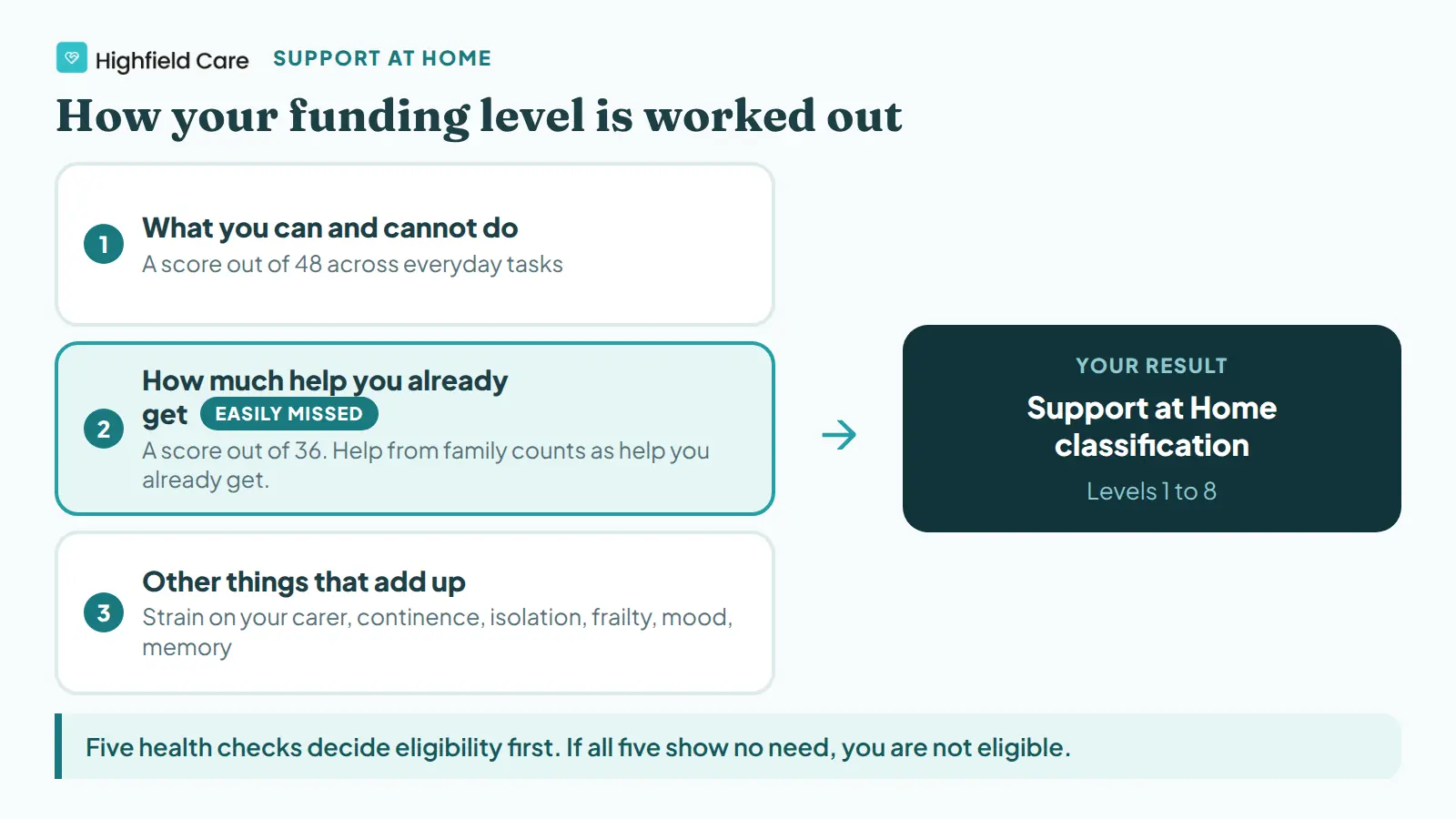
The first layer is the most intuitive: how independently you manage daily activities. The higher your independence, the less support is needed. The third layer is a list of factors that add complexity — things such as continence, cognition, frailty, anxiety and depression, social isolation, and the strain on the person currently caring for you. Each of those can lift your level.
The middle layer is the one that surprises people. It records how much of each identified need is already being met, and it is scored in the opposite direction to what most families expect: the more of your need is currently being covered — by a family member, a neighbour, or you pushing through — the lower your funded level comes out. That is not an accident of the system. It is the design, and it is why an honest account of the current situation matters far more than a brave one.
Why the help your family already gives you affects your level
Because the assessment records what is already being provided, and a need that is being met scores lower than one that is not. If a family member is quietly doing the cooking, the cleaning, the medication and the driving, the assessor may record those needs as met.
This produces a genuinely difficult situation. Families who step in — as most do — can unintentionally make the case for funded support look weaker, and the harder they work, the more the gap is hidden. The way through it is not to withdraw help or to exaggerate. It is to be explicit about who is providing it, how many hours a week it takes, and what it is costing the person doing it.
There is a specific factor designed for this: the sustainability of your current caring arrangements. If your daughter is driving over four mornings a week and has used up her leave, that is not a detail — it is a scored factor that can raise your classification. Say it plainly, and say it in hours rather than in feelings.
What decides whether you are eligible at all?
Eligibility is determined by the IAT's five validated checks, covering daily activities, self-care, frailty, mood, and cognition. If no care needs are identified across those checks, you are not eligible — but a diagnosis alone does not decide it either. It is how the condition shows up in your daily life that counts.
It is worth understanding this because it explains outcomes that otherwise look inconsistent. Two people can have the same diagnosis and very different results, because one is still managing most daily tasks and the other is not. It also means the assessor is not assessing your illness; they are assessing your functioning, and that is what you should describe.
A confirmed dementia diagnosis is one of the recognised inputs here, and cognition more broadly is one of the compounding factors. If memory or confusion is affecting daily life, it needs to be described in practical terms — missed medication, a forgotten appointment, a bill left unpaid, a pan left on the stove — rather than mentioned once as a diagnosis and left at that.
What actually happens during the visit?
The assessor will talk with you, ask you to demonstrate or describe daily tasks, and may ask to see parts of the home such as the bathroom and the kitchen. They will also ask about your carer, your medications, and any recent hospital stays or falls.
One practical point that makes a difference: the assessor can only record what they observe or are told. If you are having a good day, it is reasonable and important to describe what a bad day looks like — and how many bad days there have been this month. That is not exaggeration. It is the part of the picture that is otherwise invisible.
- Expect questions about showering, dressing, toileting, meals, cleaning, shopping, transport and medication
- Expect questions about memory, mood, sleep and how you are managing at home
- Expect questions about who helps you, and how often
- Expect to be asked about falls, hospital admissions and any recent changes
- You can ask the assessor to read back what they have recorded
- You can ask how the information will be used, and what happens next
Who should be at the assessment?
You, and anyone who helps you regularly. A family member or friend who does the practical work can describe things you may not notice or may not want to mention, and they can take notes so you do not have to remember what was said.
You are also entitled to have an advocate with you. Free independent advocacy is available through the Older Persons Advocacy Network on 1800 700 600, and it is designed for exactly this situation — someone who knows the system sitting alongside you and making sure the full picture is captured. You do not need to be in a dispute to use it.
If your carer cannot attend, write a short note in advance covering what they do and how long it takes, and hand it to the assessor. A page of specifics from the person doing the caring is often more useful than anything else in the visit. Some families arrange for someone from their provider to be there for that exact reason. It is also part of what our care coordinators at Highfield Care do — sitting with you beforehand and helping you write down what a difficult week actually looks like, so the detail is in front of the assessor rather than left to memory.
What should you have ready?
A medication list, a note of recent falls or hospital stays, and a plain description of what a difficult day looks like. Ten minutes of preparation has a real effect on the outcome.
- A list of your current medications, with doses
- Dates of any recent hospital admissions, falls or changes in your health
- A note of who helps you, what they do, and roughly how many hours a week it takes
- Examples of what you can no longer manage, with a sense of when it started
- Any diagnosis or specialist letters that are relevant
- Questions you want to ask, written down
What if you disagree with the outcome?
You can ask for a reassessment if your needs have changed, or request a review of the decision if you believe it was wrong. There are also separate short-term pathways that are funded ahead of the ongoing queue, which is the one that matters most after a hospital stay.
A reassessment is usually the faster route when something has genuinely changed — a fall, a hospital admission, a new diagnosis, or a carer who cannot keep going. Bring the same kind of specifics you would bring to a first assessment, plus what has changed since. If you are coming out of hospital, say so: Transition Care, Restorative Care and the End-of-Life pathway are separate short-term pathways rather than part of the ongoing queue, and they move much faster than a standard application.
If you believe the recorded information is actually wrong, rather than just unfavourable, say so early and in writing. The Older Persons Advocacy Network on 1800 700 600 can help you work out which process applies and how to put it forward.
What happens after the assessment?
You receive a Notice of Decision setting out the classification you have been approved for. From that date you have 56 days to sign a service agreement with a provider and start services, and you can request a 28-day extension.
Approval and funding are not the same thing, and this is where most of the frustration in the system sits. Once your Notice of Decision arrives, start talking to providers immediately rather than waiting for funding to be allocated — those conversations take time and you want a decision ready. If your full funding is not immediately available, you may be offered interim funding set at 60% of your classification so that critical services can begin while the remainder is pending.
Diary the 56-day deadline the day the notice arrives. It is one of the few deadlines in the system with real consequences for missing it, and it passes quietly.
What to do next
If you have not been assessed and you are finding things harder, request an assessment now rather than at the point of a crisis. If you have been assessed and the result does not match your situation, ask for a review.
Highfield Care is a Sunshine Coast provider, and we are glad to talk through an assessment before it happens — including the parts families most often leave out. If you would rather work out what to say before you say it, that conversation costs you nothing and commits you to nothing.
- Call My Aged Care on 1800 200 422 to request an assessment or ask about your current one
- Write your carer's contribution down in hours before the visit
- Describe your worst days, not your best ones
- Ask the assessor to read back what they have recorded
- Note your 56-day deadline when your Notice of Decision arrives
- Call the Older Persons Advocacy Network on 1800 700 600 if you want support or think an outcome is wrong