
One of the most confusing parts of the aged care system is the gap between being told you are approved and actually having someone arrive at your door. Families often assume approval means services begin, then wait weeks without hearing anything, and start ringing around unsure whether something has gone wrong. The short answer is that approval, funding and a start date are three separate steps. This guide explains what happens at each one, how long the wait really is at the moment, what the interim allocation means, and the things you can do now rather than waiting.
Why is there a wait for Support at Home?
Because being approved and being funded are two different things. An assessment decides what level of care you need, and the funding for that level is then released when it becomes available. Demand has run ahead of the funding released each quarter, so a large number of people sit approved and waiting.
It helps to picture the queue as a series of gates rather than one line. First you are assessed. Then you receive a Notice of Decision telling you the classification you have been approved for. Then funding for that classification is allocated to you. Only then can you sign a service agreement with a provider and have services actually start. Most of the frustration families experience comes from being told about gate two and assuming they are at gate four.
It is also worth knowing that the wait is not the same for everyone. It depends heavily on your classification level, on where you live, and on which services you need — some pathways move in weeks, and others take most of a year. The next section explains what the official figures actually say.
What does the wait look like, step by step?
Referral, then assessment, then a Notice of Decision, then choosing a provider, then signing a service agreement and starting. The 56-day clock starts when you receive your Notice of Decision, not when you first applied.
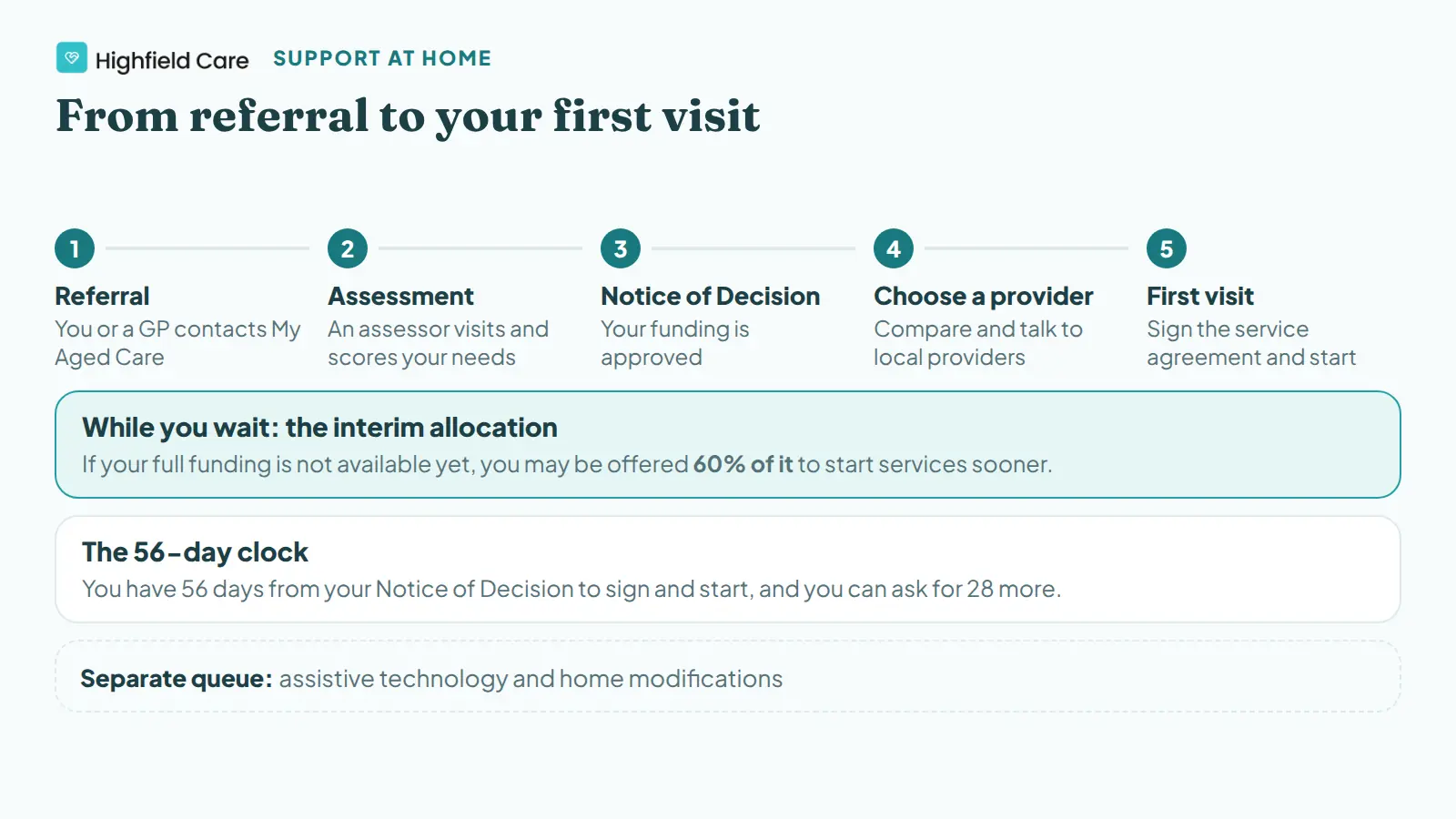
Two details in that sequence cause most of the confusion. The first is that the interim allocation can give you part of your funding before the full amount is available, which means services can sometimes begin sooner than you expect. The second is the 56-day deadline, which applies from the date of your Notice of Decision. If you let it pass without signing and starting, your allocation can be released and you can end up back in the queue — which is a much worse outcome than a slow start.
Practical advice: as soon as your Notice of Decision arrives, start talking to providers. Do not wait until funding is allocated to begin choosing, because the provider conversation takes time and you want to have a decision ready to go.
How long is the wait really?
The government's own wait-times report, covering services that started between April and June 2026, put the median wait for ongoing Support at Home at 297 days — about ten months — which is the longest of any pathway. The same report measured the median for restorative care at 64 days and for the End-of-Life pathway at 15 days.
Those figures describe people who actually started receiving services in that quarter, measured from application to commencement. That is an important caveat in both directions: it does not tell you how long the people still waiting have been waiting, and it does not reflect your own classification level, because higher and lower levels are released on different timelines. An earlier report covering November 2025 to March 2026 put the median at 347 days for ongoing Support at Home and found Queensland had the longest median of any state at 322 days.
What this means practically is that you should plan for months rather than weeks, and put supports in place in the meantime rather than waiting for the full allocation. It also means that if you are being told a wait of a few weeks for ongoing services, it is worth asking what basis that is on — the published numbers suggest otherwise.
What is the interim allocation?
If your full funding is not yet available, you may be offered interim funding set at 60% of your total classification so that critical services can begin. You are still in line for the remaining 40%, which is released when it becomes available and is not backdated. Interim funding applies to your ongoing services only.
Interim funding is the reason some people start receiving services relatively quickly while others wait much longer — it is allocated to allow participants to access critical services while the full amount is pending. The practical question is what to prioritise within 60%: usually personal care, help with showering and dressing, medication support, and meals are the things that hold daily life together, with domestic assistance and social support following behind. One limit worth knowing: interim funding covers your ongoing services only. The Restorative Care Pathway and the End-of-Life Pathway are funded immediately and in full, so if either applies to you, they are not caught by the 60%.
If you are offered interim funding, ask two questions before you agree to the plan: what is in it, and what happens when the remaining funding is released. You should be able to change the mix at that point rather than being locked into the original allocation. In our experience the hands-on support belongs at the top of a 60% plan — showering, dressing, medication and meals — with domestic help and social support following once the full allocation lands. It is a sequencing decision, not a permanent one.
What can start before your funding is allocated?
Some support does not need an aged care assessment at all. Carer support, community transport, meals services, and your GP's chronic disease management are all available independently of the aged care queue.
The mistake to avoid is treating the aged care queue as the only door. Families often wait ten months for a service that a GP referral or a local community organisation could have provided in a fortnight, simply because nobody separated the two.
- Carer Gateway on 1800 422 737 — free counselling, coaching, peer support and emergency respite for carers
- Your GP — including a GP Management Plan and Team Care Arrangements for chronic conditions, which can bring allied health within reach
- Community transport and meals services, which many people arrange directly
- Private services, where you can afford them, for domestic help or a few hours of personal care
- Your own informal network — asking a neighbour, a friend or a family member for one specific thing rather than general help
What should you do about the 56-day deadline?
From the date on your Notice of Decision you have 56 days to sign a service agreement and start receiving services, and you can ask for an extension of 28 days. If the deadline passes, your allocation can be withdrawn and returned to the pool.
The deadline exists to keep funding moving rather than sitting unused, but it catches people out constantly — particularly people who are waiting for a preferred provider to have capacity. The answer is to ask for the extension early, and to be honest with the provider you want about your deadline, because it is often the thing that speeds up your start.
If your deadline is close and nothing is arranged, ring My Aged Care on 1800 200 422 the same day and ask what your options are. Free independent advocacy through the Older Persons Advocacy Network on 1800 700 600 can also help if you are getting conflicting information.
What if the funding offered is less than you need?
You can ask for a reassessment if your needs have changed since your assessment, and you can ask for a review if you believe the decision itself was wrong. These are different processes and they have different timeframes.
A reassessment is appropriate when something has changed — a fall, a hospital admission, a new diagnosis, or a carer who can no longer manage what they were doing. A review is about whether the original decision was correct. In either case, the single most useful thing you can bring is a specific description of what has changed in daily life and a rough idea of when it started.
It also helps to write it down before you ring. Assessors are trying to record needs accurately, and a clear account of what happens on a difficult day is far more useful than a general statement that things have got harder. If a carer is doing more than they can sustain, say so plainly — the strain on a carer is a recognised factor that can raise a funding level.
Does the wait differ depending on the service?
Yes, and by a great deal. Ongoing Support at Home is the slowest pathway at a median of 297 days. Assistive technology and home modifications were measured at a median of around 101 and 102 days respectively, restorative care at 64 days, and the End-of-Life pathway at 15 days.
Two things follow from this. First, if what you need is a grab rail, a shower stool or a mobility aid, asking early is worthwhile because that pathway moves roughly three times faster than ongoing services — and a fall in the meantime is far more costly than the wait. Second, if you are coming out of hospital or your situation has fundamentally changed, ask specifically about the short-term pathways, because they are the fastest in the system and families rarely know to ask.
Assistive technology and home modifications also sit in a separate queue to your everyday services, so requesting them does not push your personal care back.
What should you do while you wait?
Get your name in early, plan for months, start provider conversations immediately, and arrange whatever does not depend on the aged care queue. Then check in regularly rather than assuming you will be contacted.
- Sign and return anything your provider sends you on the same day
- Ring My Aged Care on 1800 200 422 for a status check every few weeks
- Ask about the interim allocation specifically, rather than waiting to be offered it
- Ask about assistive technology and home modifications if either would help now
- Arrange the things that do not need an assessment, including Carer Gateway support
- Keep a written note of dates, reference numbers and the names of people you speak to
- Diary your 56-day deadline the day your Notice of Decision arrives
Where to get help while you wait
My Aged Care on 1800 200 422 for anything about your application or funding, the Older Persons Advocacy Network on 1800 700 600 for free independent advocacy, and Carer Gateway on 1800 422 737 if you are the person doing the caring.
If you are on the Sunshine Coast and trying to work out what can realistically start now, ring Highfield Care and ask us straight. We will give you an honest answer about the next month — what we can put in place, what genuinely has to wait for funding, and which of the items above you could arrange this week with or without us.