
Coming home from hospital is usually a relief, and then the first week is harder than anyone expected. Meals, medication, getting to the bathroom, the washing, the follow-up appointments — the everyday things that were managed by nurses on the ward are suddenly back in your hands, often at a point when you are still recovering. There is also a piece of good news that most families never hear: the short-term care pathways that follow a hospital stay are the fastest in the aged care system, and they can be arranged without the usual wait. This is what to do before, during and after the trip home.
What should be arranged before you leave hospital?
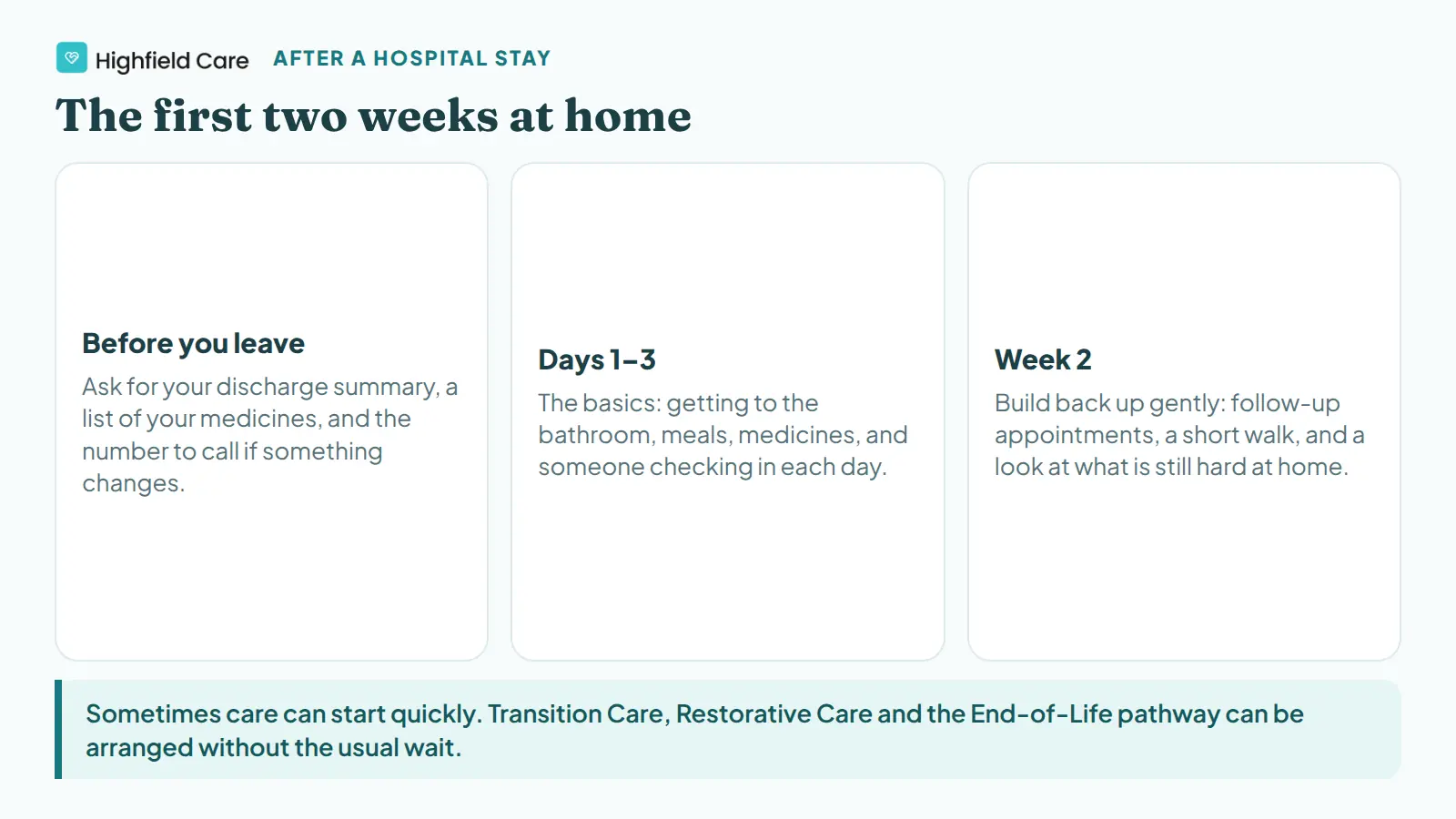
Before you leave, ask for three things: a written discharge summary, a list of your medicines with any changes marked, and the number to call if something goes wrong after hours. If you do not have those three things, you are going home without the information that keeps you safe.
Hospitals have discharge planners, social workers and ward nurses whose job is to organise what happens next. Ask to speak to one of them, and do it as early as you can rather than on the morning you are leaving. If you are going home to an empty house, or to someone who cannot manage your care alone, say so plainly — that is exactly the information they need to arrange support.
It also helps to ask one direct question: what is the plan for the first week? A hospital can usually arrange short-term support, a district nurse visit, or a follow-up appointment, but only if someone is asked. If you are not sure who to ask, ask the nurse in charge of the ward and they will direct you.
What do the first two weeks at home look like?
The first 48 hours are about the basics — getting out of bed safely, getting to the bathroom, eating, drinking and taking the right medicines at the right time. Week two is about gradually building back up and noticing what is still difficult.
It is very common to feel worse at home in the first few days than you did in hospital, and that is not necessarily a sign something is wrong. On the ward you had company, meals, regular checks and someone to notice if you were unsteady. At home all of that is on you, and the drop in activity is real. The important thing is to notice specific problems rather than general tiredness.
Plan the first week around the few things that genuinely must happen: medication on time, food you can actually prepare, and a way to get to the bathroom at night without falling. Everything else can wait until you are stronger.
Which kinds of care can start quickly?
Three pathways can be arranged quickly after a hospital stay: Transition Care, Restorative Care, and the End-of-Life pathway. They sit outside the ordinary ongoing queue, and restorative care and End-of-Life funding is released immediately, which is why they start so much faster than an ordinary approval.
Transition Care is the one most people use after a hospital admission. It is short-term support focused on getting you back to independence rather than settling into long-term care, and it can include personal care, nursing, allied health such as physiotherapy and occupational therapy, and domestic help. Restorative Care works the same way over a longer window, for people who need to rebuild strength after illness or a fall. Each of these has time limits, so it is worth asking what they are and what happens when the period ends.
This is a genuinely useful thing to know because it explains a confusing situation many families hit. Two people can make the same phone call to My Aged Care with the same needs and get completely different answers, because one is coming out of hospital and qualifies for a fast-tracked pathway, and the other is not. If you are in hospital, say so.
How do you get this started?
Ask the hospital's discharge planner or social worker to make the referral, and follow it up yourself with My Aged Care on 1800 200 422. You do not have to wait to be offered short-term care — you can ask for it by name.
If you are already an approved Support at Home client, ring your provider before the admission or as soon as you can. Most issues families hit at this point are not about funding — they are about the office not knowing you were in hospital, so visits were missed and the restart is delayed by a week. One phone call prevents that. Families coming home from Sunshine Coast University Hospital and Nambour often ring us from the ward for the same reason, and we will tell you honestly what can realistically be arranged by the day you arrive home.
- Tell the discharge planner you want to be assessed for short-term care before you leave
- Ask which pathway applies to you, and what the time limit is
- Call My Aged Care on 1800 200 422 and ask about the short-term pathways specifically
- If you are already with a provider, tell them the date you will be home so visits restart immediately
- Ask your GP for a follow-up appointment in the first fortnight, and book it before you leave
- Write down the after-hours number and put it somewhere you can find it
What about medicines after a hospital stay?
Medication changes are one of the most common causes of a readmission, and the risk is highest in the first week. Ask for a written list of what you are taking now, what has stopped, and what has changed — and do not rely on the old boxes in the cupboard.
If you take several medicines, ask whether a pharmacist medication review is possible, or whether your doses can be packed into a blister pack so you can see at a glance whether they have been taken. If remembering doses is genuinely difficult, that is a care need worth mentioning in any assessment — support with self-administering medication is a service that can be funded.
It is also worth telling whoever helps you at home what to watch for. A carer who knows that a new tablet can cause dizziness will notice it and say something, where someone without that information will simply think you are tired.
What should the family keep an eye on?
Watch for a return of the problem that took you to hospital, a new confusion or drowsiness, a fever, a wound that looks worse, or a fall. Any of those needs a call the same day — not a wait-and-see.
Outside the hospital, the practical options are your GP, the after-hours GP service, or 13 HEALTH in Queensland on 13 43 25 84, where a registered nurse will tell you whether you need to be seen urgently. For anything that looks like a heart attack, a stroke or a serious fall, call 000 and do not drive.
- New or worsening confusion, or unusual drowsiness
- A temperature, or feeling shivery and unwell
- A wound, dressing or catheter that looks or smells different
- Not drinking, not eating, or not passing urine normally
- Any fall, even one that did not hurt
- Breathlessness, chest pain, or a new swelling in a leg
How do you reduce the risk of going back?
Most readmissions are caused by falls, medication problems, dehydration and untreated infections. All four are things you can influence in the first fortnight, and a home safety check is worth more now than at any other time.
Ask for a home assessment if you have not had one. An occupational therapist or a support worker can identify the things that will cause a fall — a loose mat, a dark hallway, a shower with nothing to hold, a bed that is too low or too high, a step at the front door — and many of those can be funded through Support at Home.
If you are on your own, structure helps more than motivation. Set times for meals and for getting up and moving, keep water within reach of where you sit, and accept the offers of help while you need them. Building back up is gradual, and doing less now usually means doing more later.
Who arranges and pays for all this?
Short-term pathways such as Transition Care are arranged through the health system or My Aged Care, while longer-term support runs through Support at Home. Some supports are fully government-funded and others carry a contribution, and your provider must set out what you will be charged before services start.
You should not have to work this out from scratch in the week you get home. If it is unclear what has been approved, what has been referred, and what you are expected to pay, ring My Aged Care on 1800 200 422 and ask them to confirm it. Free independent advocacy is available through the Older Persons Advocacy Network on 1800 700 600 if you want someone to help you sort it out.
Discharge planning is one of the things we do most of on the Sunshine Coast. If an admission is coming up, or you are reading this from a ward, ring Highfield Care and we will work through what needs to be in place before you get home — and what can safely wait until you are back on your feet.
A checklist for the day you leave
Work through this before you walk out of the ward. Ten minutes now saves a difficult week.
- Discharge summary in hand
- Written medication list, with changes marked
- Follow-up appointment booked, not just promised
- Short-term care referral made, and written down by whom
- After-hours contact number written down, not just in an app
- Food in the house, and a plan for the first three dinners
- Someone told which day you are arriving home
- Your provider told, if you already have one, so visits restart immediately