
Most people living with dementia want to stay in their own home, and for many people that is entirely possible with the right support in place. The difficulty is usually not deciding what you want. It is working out what help actually exists, what it covers, and who to ask. This guide sets out what in-home dementia care involves, how a dementia diagnosis changes an aged care assessment, what makes a home safer, and how families on the Sunshine Coast can organise support without having to become experts overnight.
What does in-home dementia care actually cover?
In-home dementia care covers the practical things that keep daily life working: memory and routine, safety at home, personal care such as showering and dressing, meals, and company and activity. It also covers giving the family carer a break, because caring without one is not sustainable.
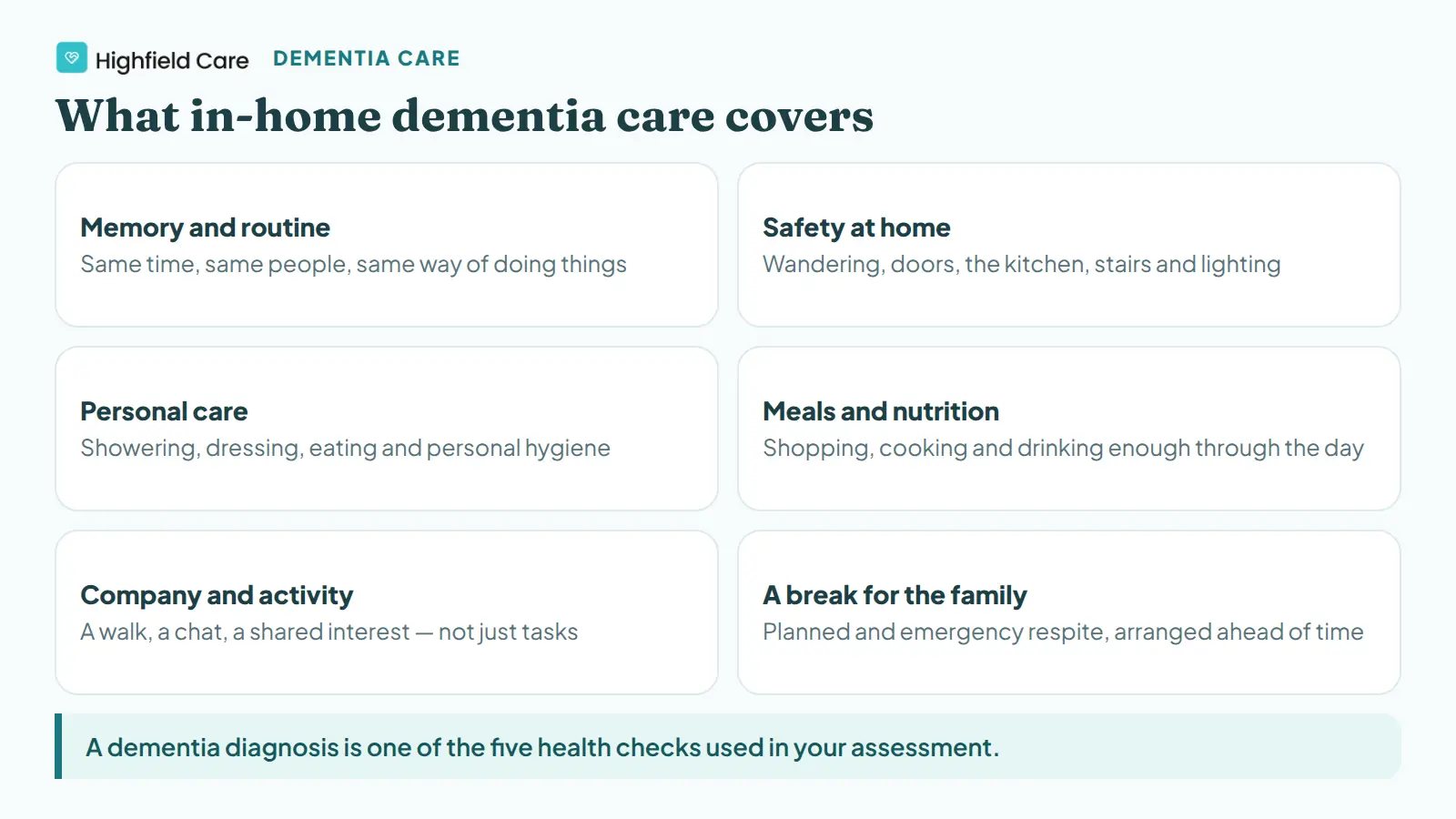
It helps to separate dementia care from the idea of a clinical service. A lot of what makes a difference is ordinary: the same person arriving at the same time, a shower taken the same way each morning, a meal that actually gets eaten, a walk and a conversation. Consistency matters more in dementia care than in almost any other kind of support, because familiarity reduces confusion and distress.
Dementia care at home is also not one thing. Some people need a few hours a week of company and prompting. Others need hands-on help with showering and dressing every day, plus someone to make sure the medication is taken and the front door is locked at night. Your support can start small and grow as needs change, and it can be adjusted without starting over.
How does a dementia diagnosis affect your aged care assessment?
A confirmed dementia diagnosis is one of the five health checks used to decide whether you are eligible for Support at Home, and cognition is also one of the compounding factors that can raise your classification level. In plain terms, a diagnosis is not just a medical fact — it is a factor the assessment is designed to record.
The assessment looks at three things: what you can and cannot do, how much of your need is already being met, and a set of compounding factors. Cognition sits in that third group, alongside continence, social isolation, frailty, anxiety and depression, and the strain on the person already caring for you. All of those are scored, and any of them can move you to a higher level of funded support.
This is why it matters that dementia is mentioned clearly at the assessment, and why it helps to describe how memory changes show up in daily life rather than leaving it at the diagnosis. Two people with the same diagnosis can be managing very differently — one may be safely cooking and paying bills with reminders, another may have left the stove on twice this month. The assessment can only record what it is told, so it is worth being specific about what is actually happening at home rather than what you hope will happen.
Is it safe to keep living at home with dementia?
Usually yes, particularly in the earlier and middle stages, and often with some adjustments. The question is not whether someone has dementia but which specific things have become risky — and nearly all of those can be managed with support, changes around the home, or both.
Home modifications and some assistive technology can be funded through Support at Home. It is worth knowing that these sit in a separate funding queue to your everyday services, so if something like a grab rail or a sensor mat would help, ask about it early rather than waiting until a fall has already happened.
There is also a point where a home simply asks more of one person than one person can give. That is not a failure, and it is not a reason to move someone out of their home. It is usually the moment to increase support — more hours, a night visit, or respite — rather than to make a decision about the long term.
- Wandering: door sensors, a well-lit path, a familiar routine, and letting neighbours know
- The kitchen: an automatic switch-off kettle, a microwave instead of a stove, and meals delivered or prepared
- Medication: a blister pack or a supervised dose rather than a full bottle in a cupboard
- The bathroom: grab rails, a shower stool, and a non-slip mat
- Stairs and lighting: night lights on the route to the bathroom, and handrails on both sides
- Bills and money: a family member or a trusted service taking over payments early, before a missed notice becomes a disconnection
How do you communicate well when words get harder?
Slow down, use short sentences, ask one thing at a time, and give the person time to answer. When someone is struggling to find words, correcting them rarely helps and often causes distress — the goal is connection, not accuracy.
It also helps to keep the same carer visiting where you can. A familiar face removes an entire layer of explaining and re-explaining, and it is one of the simplest things you can ask a provider to organise. If you are comparing providers, this is a good question to ask before you sign.
- Get their attention first — say their name, and make eye contact before you start
- One idea per sentence, and one question at a time
- Offer choices rather than open questions, for example 'tea or water?' instead of 'what would you like?'
- Use the person's own words for things if they use different ones
- Watch for the pattern of the day: many people are clearer in the morning and find late afternoon harder
- Don't argue about a fact that does not matter — join the feeling instead
What does in-home dementia care cost?
What you pay depends on your classification level, which services are in your plan, and whether those services are fully funded or carry a contribution. You should never have to guess: providers must publish their prices, and your service agreement must set out what you will be charged before services start.
Two things are worth knowing. First, some supports are fully government-funded and others involve a contribution, so the split matters more than a single total. Second, help with personal care such as showering and dressing has been fully government-funded since 1 October 2026, with no out-of-pocket cost to you.
If you are trying to work out what your own costs are likely to be, use the official Support at Home tools on the My Aged Care website as an independent check against anything you are told. If an invoice or a statement does not match the agreement you signed, ask the provider to explain the difference in writing.
What should you look for in a dementia care provider?
Look for consistency of carers, staff trained in dementia specifically rather than in aged care generally, a written care plan you helped build, and a provider who will talk to the family openly. Experience with the local area helps too, because it means shorter travel between visits and more reliable time slots.
Ask to meet the people who will actually visit, not just the person who does the assessment. In practice the relationship with the individual carer is what families remember, and it is reasonable to ask how it will be protected when staff are sick or on leave. Consistency is what we roster around at Highfield Care: a small group of familiar support workers, built around the person's existing routine rather than the other way around.
- Can the same small group of carers be assigned to us?
- What dementia-specific training do your staff have, and how is it kept current?
- Can you provide every service in my plan, including respite?
- How do you handle evenings, weekends and a sudden change in needs?
- How will you keep the family informed without breaching my privacy?
- What happens if we need more support at short notice?
Getting help as the family carer
You are entitled to support in your own right. The strain on a family carer is a recognised factor in the aged care assessment, which means that asking for a break is not an indulgence — it is part of the care plan.
Respite can look like a few hours while you go to an appointment, a day or an overnight, a few days away, or emergency respite when something changes suddenly. Planning it in advance is much easier than arranging it in a crisis, and it means the person you care for becomes used to the person who steps in.
Carer support groups and counselling are also available, and Dementia Australia runs a national helpline on 1800 100 500 staffed by people who understand what you are dealing with. Many carers say the same thing: the practical help mattered, but so did talking to someone who did not need the situation explained from the beginning.
Where to get help on the Sunshine Coast
Start with My Aged Care on 1800 200 422 to check eligibility or your current plan, then talk to local providers who already deliver dementia care in the area. Free independent advocacy is available through the Older Persons Advocacy Network on 1800 700 600 if you want someone alongside you at meetings.
Local matters in dementia care for a practical reason: visits in Tewantin, Noosa, Cooroy and the surrounding suburbs are short trips only if the provider already works there. A provider travelling from an hour away will struggle to fill a one-hour visit reliably, and it is usually the first thing that slips when they are short-staffed.
If you are unsure whether the support already in place is still the right amount, or you are looking for help for the first time, ring Highfield Care about dementia care at home on the Sunshine Coast and we will go through it with you. Nothing has to be decided on the call, and asking commits you to nothing.
What to do this week
Pick the one thing that would make the biggest difference and start there. It is usually safety or the carer's own exhaustion — not a long-term decision about the future.
- Write down what has actually changed in the last three months, not just the diagnosis
- Check your current plan covers what you now need, and ask for a review if it does not
- Fix the single most dangerous thing in the house first
- Book a break for the carer, even a few hours, and put it in the calendar
- Call Dementia Australia on 1800 100 500 if you want to talk it through with someone independent