
If you are the person who does the caring, you already know that the hardest part is not any single task. It is never being off duty. Respite care exists for exactly that reason, and it is a legitimate part of an aged care plan rather than something you have to justify. What stops most families is not knowing what is available, what it costs, or how to ask — so this guide covers the four kinds of break, how to arrange them on the Sunshine Coast, and what makes respite actually work for the person you care for.
What is respite care, and who is it for?
Respite care is short-term support that gives a family carer a break, and it is funded through Support at Home. It can be a few hours in your own home, a day or an overnight, a few days in a respite centre, or emergency respite when something changes suddenly.
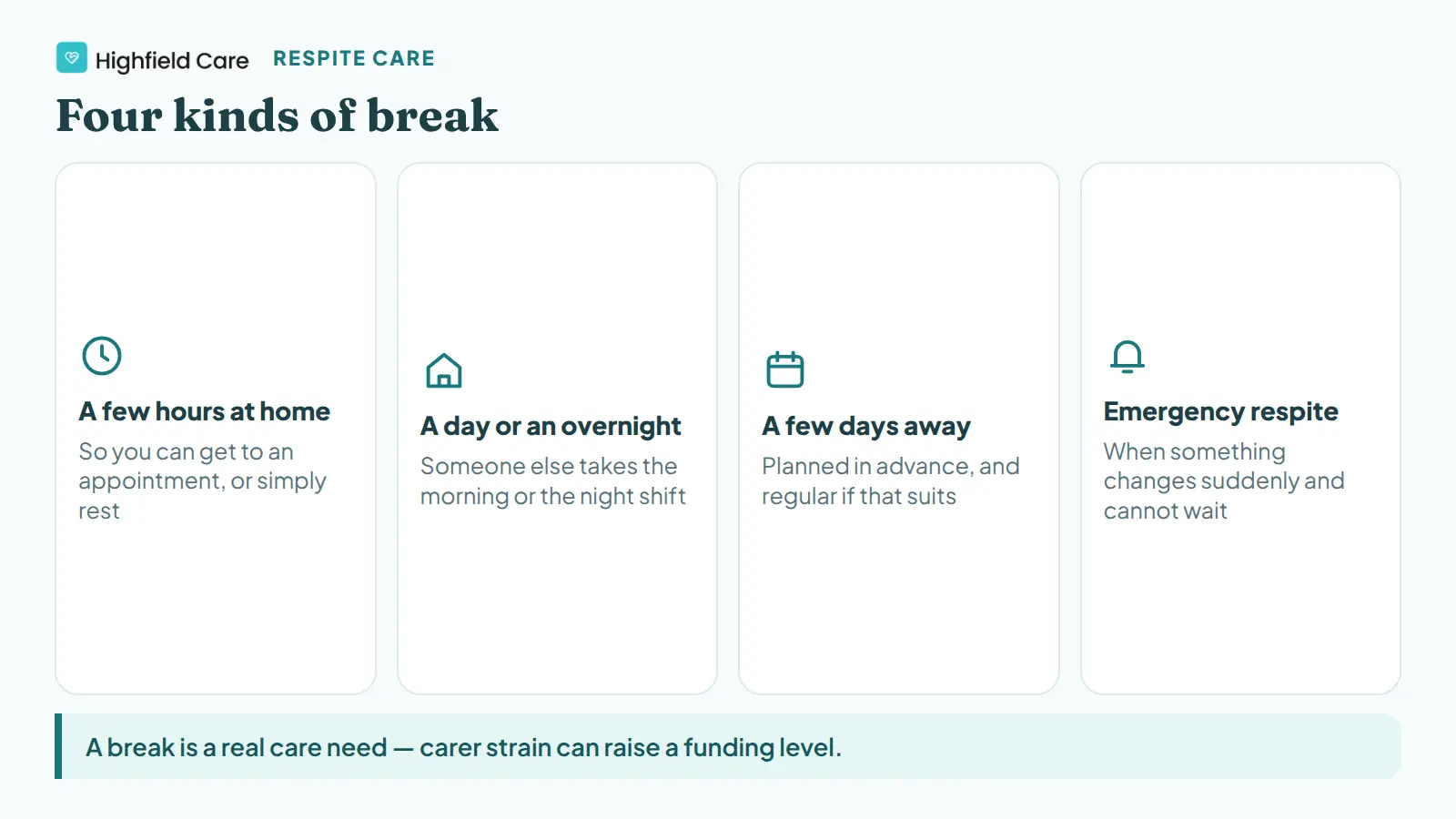
Respite is for the carer as much as for the person receiving care, and the aged care system recognises that. The strain on a family carer is one of the compounding factors recorded in an aged care assessment, and a high level of carer strain can raise the funding level. In plain terms: the person you care for is more likely to get funded support if the assessor understands how much you are doing, not less.
That is worth repeating because it runs against what many carers assume. Families often play down how much they are managing, hoping it will strengthen the case for help later. In practice, describing the real situation accurately is what produces the funded support — including the respite hours that make the arrangement sustainable.
How do you arrange respite on the Sunshine Coast?
If you are already with a provider, ask them directly — respite is a service in the Support at Home program and it can be added to your care plan. If you are not yet assessed, ring My Aged Care on 1800 200 422 and ask to be assessed, and say clearly that you are the carer and you need a break.
One practical tip that makes a real difference: book the break as a recurring appointment on a set day, rather than ringing up when you are desperate. A regular Tuesday morning is easier for a provider to staff, easier for you to plan around, and much easier for the person you care for to accept, because it becomes part of the routine instead of an event.
- Ask your current provider to add respite to your care plan and book it in advance
- If you are not assessed yet, call My Aged Care on 1800 200 422 and ask for an assessment
- Say explicitly that you are the carer, and describe what happens without a break
- Call Carer Gateway on 1800 422 737 for free carer counselling, coaching and local support
- If it is urgent, ask about emergency respite rather than waiting for the regular booking
What is the difference between in-home respite and a respite centre?
In-home respite means a support worker comes to your home and takes over the caring while you leave. Centre-based respite means the person travels to a day centre or a residential setting for a period of time. In-home is usually easier to arrange and easier to accept; centre-based gives you a longer and more complete break.
In-home respite is the gentler starting point. The person stays in their own surroundings with their own bathroom, own chair and own routine, and the only change is who is standing in the kitchen. That makes it the right first step for someone who is reluctant, or who becomes distressed by unfamiliar places. It is also the most useful form for a carer who needs to work, sleep, attend their own appointments, or simply have a few uninterrupted hours.
Centre-based and overnight respite takes more planning but delivers something in-home cannot: complete time off, including the night. If you have not slept properly in months, an overnight or a few days away is usually the single most valuable support you can arrange. It typically needs booking further ahead and may involve a visit beforehand so the person knows the place and the faces.
Can you get emergency respite?
Yes. Emergency respite exists for situations that cannot wait — a sudden illness, a hospital admission, a family crisis, or a carer who has reached the point where they cannot continue this week. It is arranged through My Aged Care on 1800 200 422, and you should say plainly that it is urgent.
Emergency respite is not a loophole and you do not need to prove a crisis is serious enough. The honest test is simple: if you cannot safely keep going this week, it is an emergency. Carers routinely wait far too long before making this call because they feel they should manage — and a carer who collapses puts two people at risk instead of one.
It is worth knowing this pathway exists even if you never need it, because the worst time to learn how the system works is in the middle of the night when something has gone wrong. If you would like, we can talk through what emergency respite would look like for your situation now, while nothing is urgent.
How much respite is funded?
Respite is funded through your Support at Home budget at a level set by your classification, and it does not carry a separate charge of its own beyond your normal arrangements. Your provider must set out what you will be charged before services start, and respite should appear in your care plan like any other service.
Because respite draws on the same budget as other services, the practical question is how to allocate it — and this is where families often under-ask. If caring is affecting your health, your sleep or your ability to keep working, that is a strong argument for a higher proportion of the plan going to respite, and it is worth saying so when the plan is being built or reviewed.
If funding arrangements are unclear, ring My Aged Care on 1800 200 422 and ask them to confirm what has been approved, and use the official Support at Home tools on the My Aged Care website to check costs independently.
What should you prepare for the first respite visit?
Write down the routine rather than expecting anyone to guess it. When meals happen, what the person likes and refuses, how they take their medication, how they like to be helped in the shower, and what upsets them. That one page is the difference between a calm visit and a difficult one.
Give the worker a chance to be briefed properly, and be honest about the difficult parts. If the person becomes agitated in the late afternoon, or refuses to shower from a particular carer, the worker needs to know before they arrive rather than discovering it. Nothing you say will be treated as a complaint about the person you care for — it is information that makes the visit work.
- Medications, with times and doses, and where they are kept
- The daily routine — waking, meals, rest, bedtime
- What the person can do independently, and where they need help
- How they prefer to be helped with showering and dressing
- Food and drink they like, and anything they must avoid
- What causes distress, and what settles it
- Emergency contacts, GP details, and any advance care documents
- Whether there is a pet, and what the pet needs
What if the person you care for refuses respite?
Start smaller than you think you need to, and make the first visit about company rather than care. A short visit framed as a chat and a cup of tea is far easier to accept than arriving to be looked after, and once there is a familiar face, the practical help can be introduced naturally.
It also helps to be matter-of-fact rather than apologetic. If the break is presented as something you are doing because you need it — a medical appointment, a class, a commitment — it lands very differently from a suggestion that they need supervision. Many families find that the person they care for is more willing to accept help when it is clearly for the carer's sake rather than their own.
Keep the first few visits short and predictable, keep the same worker if you can, and build up. Consistency is the single biggest factor in whether respite works.
The guilt is normal, and it is not a reason to wait
Almost every carer feels guilty the first time they take a break, and most feel differently within a month. Taking a break is what makes long-term caring possible — it is part of the care, not a departure from it.
There is a practical version of this too. Carers who never take a break tend to reach a point where they cannot continue at all, and that usually arrives suddenly, at the worst possible moment, and with far fewer options than were available six months earlier. Booking regular respite early is not self-indulgence; it is the thing that keeps the arrangement stable.
If the guilt is affecting you, or if you are struggling with sleep, mood or your own health, Carer Gateway on 1800 422 737 offers free counselling and coaching for carers. It is a service for you, not for the person you care for, and it does not require an aged care assessment.
Local respite on the Sunshine Coast
Most in-home respite on the Sunshine Coast is delivered by providers who already work in your suburb, and travel time is what determines whether a short visit is workable. If a provider is coming from an hour away, a two-hour booking is really a one-hour booking.
That is why it is worth asking which postcodes a provider actually covers, and how long the worker's travel is between visits. In Tewantin, Noosa, Cooroy and the surrounding areas, a local provider can fill a two-hour morning visit properly, where a distant one often cannot. It also means the same worker can realistically return, which matters more in respite than anywhere else. Highfield Care provides in-home respite care on the Sunshine Coast across those suburbs, so a booked two hours is two hours of care, and the worker your husband or mother already knows can usually come back the following week.
Day programs and social groups in the region can also provide a different kind of break — one built around activity and company rather than personal care. Several families use a combination: a centre-based day once a week, in-home respite on another morning, and an overnight every few months. If you would like help working out which mix suits you, that is the conversation we have most often — ring Highfield Care and we will tell you what is worth booking first.
A checklist before your first break
Ten minutes of preparation makes the first break much calmer for everyone, including you.
- Routine, medications and preferences written on one page
- Emergency contacts and GP details on the fridge
- The worker's name confirmed, and the same person requested for next time
- A recurring time slot booked, not a one-off
- Your own plans made, so the time off is actually used
- A second break booked before the first one finishes